
Which Hardy Geraniums Work as Ground Cover in Dry Shade Under Trees?
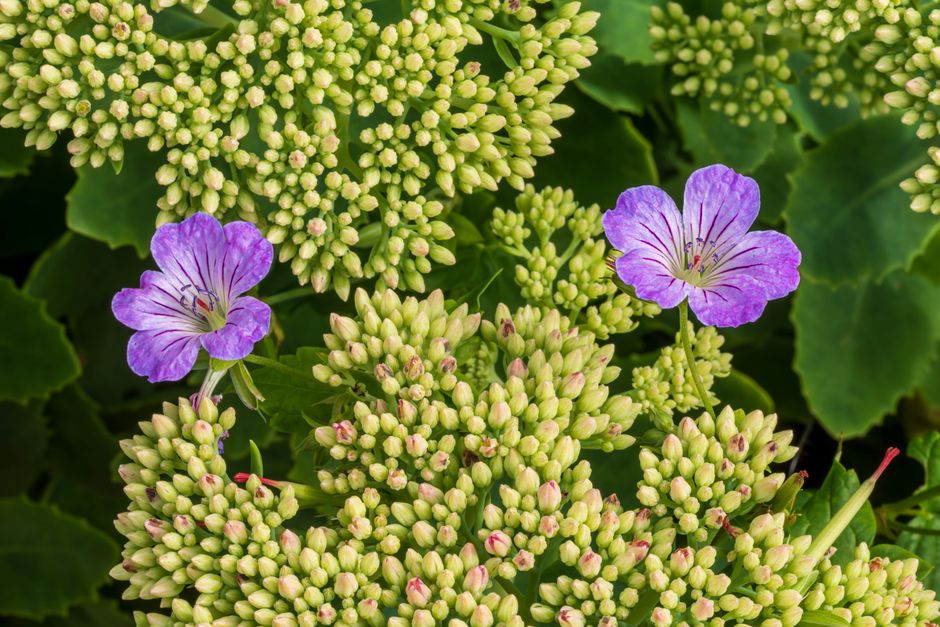
For dry shade beneath mature trees, choose bigroot geranium (Geranium macrorrhizum) first, with wild spotted geranium (G. maculatum) for suitable dry-shade sites. Bigroot geranium spreads by rhizomes, handles dry soil and part shade, and flowers in spring to summer. Plant small divisions around roots, water deeply during establishment, and contain its spread with a spade if needed.
Which hardy geraniums will tolerate dry part shade under trees?
Bigroot geranium is the soundest hardy geranium for dry part shade under trees. Penn State Extension lists it among perennials for dry shade, and the University of New Hampshire lists cranesbill, G. macrorrhizum, for dry to medium soil from full sun to part shade.
This is not ordinary shade. Mature trees take water first. As Penn State puts it, “Tree roots absorb the available moisture and, when competing with other plants, always win.” Light also shifts with the season. A plant chosen for this spot must accept both pressure points: less water and less dependable light.
Bigroot geranium does. Kew Science describes it as an aromatic perennial with a thick, fleshy rhizome, useful as ground cover in dry, shady places. Its flowers are pink, reddish-purple, or, less often, white, appearing from spring into summer.
Wild spotted geranium, G. maculatum, is also on Penn State's dry-shade list. The supplied sources do not provide its mature spread, flowering range, or control method. That leaves bigroot geranium as the better documented choice when the brief is ground cover that must endure.
| Plant | What the sources support | Ground-cover trade-off |
|---|---|---|
| Geranium macrorrhizum | Dry to medium soil; full sun to part shade; drought tolerant; USDA Zone 4 in the UNH fact sheet | Rhizomatous spread gives coverage, but needs an edge |
| Geranium maculatum | Listed by Penn State for dry shade | The supplied research gives no comparable spread or maintenance detail |
| Geranium 'Rozanne' | Full sun or partial shade; moist, well-drained soil; flowers best in full sun | Clump-forming, 1 to 2 feet wide; less suited to heavy dry shade |
| G. x cantabrigiense 'Biokovo' | 9 inches tall and 20 inches wide; spring to early-summer bloom | Compact dimensions support controlled coverage, though dry-shade tolerance is not established in the supplied research |
UNH describes bigroot geranium as a 12- to 16-inch perennial. Iowa State lists 'Ingwersen's Variety' at 14 inches tall and 42 inches wide, with spring flowers. That width is the useful fact. One plant covers ground; a whole bed does not become a blank check.
Spread is not invasion. Kew says G. macrorrhizum becomes slightly invasive in some gardens, then gives the remedy: cut through the rhizomes with a spade. Set the boundary before the plants meet it. A ground cover without a boundary is a future chore.
What geranium can grow under a mature maple tree?
Bigroot geranium is the best-supported choice under a mature maple because the sources support it for dry shade and root competition, not because they name maple trees. Public material in this research does not give a maple-specific geranium recommendation. It does define the growing problem: a mature tree underplanting faces shade, dry soil, and roots that outcompete nearby plants.
Planting technique carries as much weight as the plant label. Penn State Extension advises starting about 1 foot from the trunk. Use small plugs, seedlings, or divisions. Make each hole as small as possible.
If digging exposes a root 2 inches or more in diameter, refill the hole and choose another space. Do not cut the root to fit the geranium. Work around the tree's structure, not against it.
- Set plants in the open pockets between larger roots, beginning about 1 foot from the trunk.
- Cover the soil with 1 to 2 inches of finely shredded bark mulch or compost after planting.
- Check soil moisture at least weekly in the first growing season.
- Water deeply enough to wet the 3- to 6-inch root zone, following UNH guidance for new groundcovers.
- Continue deep weekly watering through the first year or two, as Penn State recommends for tree underplantings.
Colorado State Extension makes the same point in dry-land terms: xeric plants need more water while they establish. Drought tolerance describes the settled plant. It does not excuse a dry first season.
Mulch helps, but it is not a substitute for watering. UNH recommends a 2- to 3-inch layer of coarse organic mulch to limit weeds and erosion as groundcovers fill in. Penn State calls for the thinner 1- to 2-inch layer of finely shredded bark mulch or compost around tree underplantings. The overlap is clear: mulch the surface, keep the planting holes small, and water below the surface.
A tree bed is part of the home's visible frame. Where it sits beside a path or doorway, the planting should remain low and controlled, much like the choices in How Can I Make a Small Front Entrance or Porch Feel Welcoming Without Blocking the Door?. Coverage is the aim. Bulk is not.
Will hardy geraniums flower in dry shade?
Hardy geraniums flower in dry shade, but expect a shorter, seasonal display rather than the longest bloom offered by sun-loving cultivars. Iowa State says most hardy geranium species and cultivars bloom for 2 to 4 weeks from mid- or late spring into summer when grown in well-drained soil from full sun to part shade.
Bigroot geranium fits that rhythm. Kew places its pink to reddish-purple flowers from spring to summer. Iowa State lists 'Ingwersen's Variety' as a spring bloomer and 'Lohfelden' from spring into early summer. Foliage and coverage do the longer job.
'Rozanne' creates a different expectation. Iowa State lists purple-blue flowers from early summer to fall and a width of 60 inches. North Carolina State says it flowers best in full sun and calls for moist, well-drained soil. Long bloom has a cost: more light and more reliable moisture. Under dense dry shade, it is the wrong bargain.
Colorado State includes both G. macrorrhizum and G. sanguineum in its dry-shade table. The supplied material does not state that G. sanguineum will provide the same root-competitive ground cover beneath a mature tree. Choose it only after matching its site needs with local plant information beyond this research.
There is a useful division of labor. Flowers mark the season. Foliage holds the ground. Iowa State University Extension and Outreach also distinguishes true hardy Geranium from tender Pelargonium bedding geraniums. Buy the botanical genus, not the familiar common name.
Frequently Asked Questions
Which geraniums make ground cover without self-seeding everywhere?
Geranium macrorrhizum is the clearest choice in the supplied sources because it forms a rhizomatous ground cover rather than being identified for widespread self-seeding. Its rhizomes spread, so it still needs an edge. Kew says a gardener can contain the plant by cutting through the rhizomes with a spade.
Is Geranium macrorrhizum better for dry shade than Rozanne?
For a dry, root-filled shade site, Geranium macrorrhizum is the better fit. Penn State, Kew, UNH, and Colorado State list or describe it for dry shade, while NCSU specifies moist, well-drained soil for Rozanne and says it flowers best in full sun. Rozanne suits a brighter, less dry spot.
How do I establish geraniums where tree roots make the soil dry?
Start about 1 foot from the trunk with small plugs, seedlings, or divisions, and keep holes as small as possible. Move the planting site if a root 2 inches or wider is exposed. Mulch after planting and water deeply once a week through the first year or two, rather than giving frequent shallow watering.
Sources
- Penn State Extension: Underplanting Trees: Respect the Roots
- University of New Hampshire Extension: Groundcovers Fact Sheet
- Kew Science: Geranium macrorrhizum
- North Carolina State Extension Gardener Plant Toolbox: Geranium 'Rozanne'
- Iowa State University Extension and Outreach: Growing Perennial Geraniums
- Colorado State University Extension: Xeriscaping Retrofit Your Yard